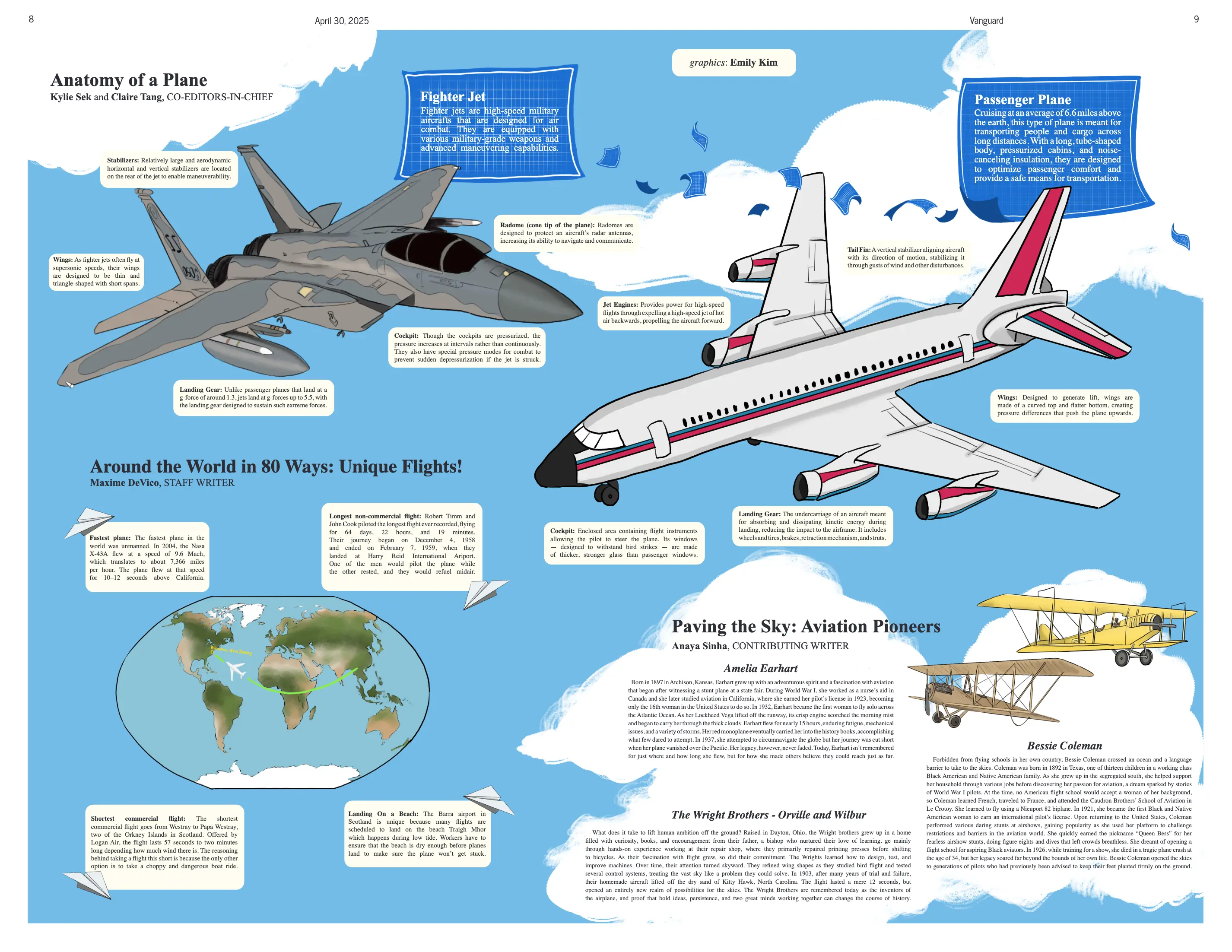
Fighter Jet
Fighter jets are high-speed military aircrafts that are designed for air combat. They are equipped with various military-grade weapons and advanced maneuvering capabilities.
Stabilizers: Relatively large and aerodynamic horizontal and vertical stabilizers are located on the rear of the jet to enable maneuverability.
Wings: As fighter jets often fly at supersonic speeds, their wings are designed to be thin and triangle-shaped with short spans.
Landing Gear: Unlike passenger planes that land at a g-force of around 1.3, jets land at g-forces up to 5.5, with the landing gear designed to sustain such extreme forces.
Cockpit: Though the cockpits are pressurized, the pressure increases at intervals rather than continuously. They also have special pressure modes for combat to prevent sudden depressurization if the jet is struck.
Radome (cone tip of the plane): Radomes are designed to protect an aircraft’s radar antennas, increasing its ability to navigate and communicate.
Passenger Plane
Cruising at an average of 6.6 miles above the earth, this type of plane is meant for transporting people and cargo across long distances. With a long, tube-shaped body, pressurized cabins, and noise-canceling insulation, they are designed to optimize passenger comfort and provide a safe means for transportation.
Tail Fin: A vertical stabilizer aligning aircraft with its direction of motion, stabilizing it through gusts of wind and other disturbances.
Jet Engines: Provides power for high-speed flights through expelling a high-speed jet of hot air backwards, propelling the aircraft forward.
Wings: Designed to generate lift, wings are made of a curved top and flatter bottom, creating pressure differences that push the plane upwards.
Landing Gear: The undercarriage of an aircraft meant for absorbing and dissipating kinetic energy during landing, reducing the impact to airframe. It includes wheels and tires, brakes, retraction mechanisms, and struts.