Stepping into the Art@Bainbridge exhibit from the busy Nassau Street sidewalks, we are immediately hit with the quiet but profound intensity of the exhibit. Inside the historic Bainbridge building sits Princeton University Art Museum’s “Roberto Lugo / Orange and Black” exhibit, curated by the Associate Curator of Ancient Mediterranean Art Dr. Carolyn Laferrière.
While ancient Greek ceramics, originating from over two thousand years ago, and 21st-century social oppression may seem to have little in common, Lugo’s work finds a way to blend these motifs together into pieces of art.
Based in Philadelphia, Lugo is an artist, ceramicist, and social activist, striving to portray communal stories of oppression and social injustices. The ceramics portray the daily lives of contemporary individuals in an ancient medium, fusing together the past, present, and future. Lugo believes that just as the daily life of ancient Greek civilizations has been crystallized in these ceramics, stories of contemporary injustice also deserve to be preserved in pottery.
“He really sees himself as tasked with archiving the stories of underrepresented peoples and to show his own lived experience and the lived experience of his communities,” said Laferrière. “To bring them into a museum … and to [show] Roberto Clemente or Harriet Tubman or Ruby Bridges, is significant because it’s giving them a place within the history of American art.”
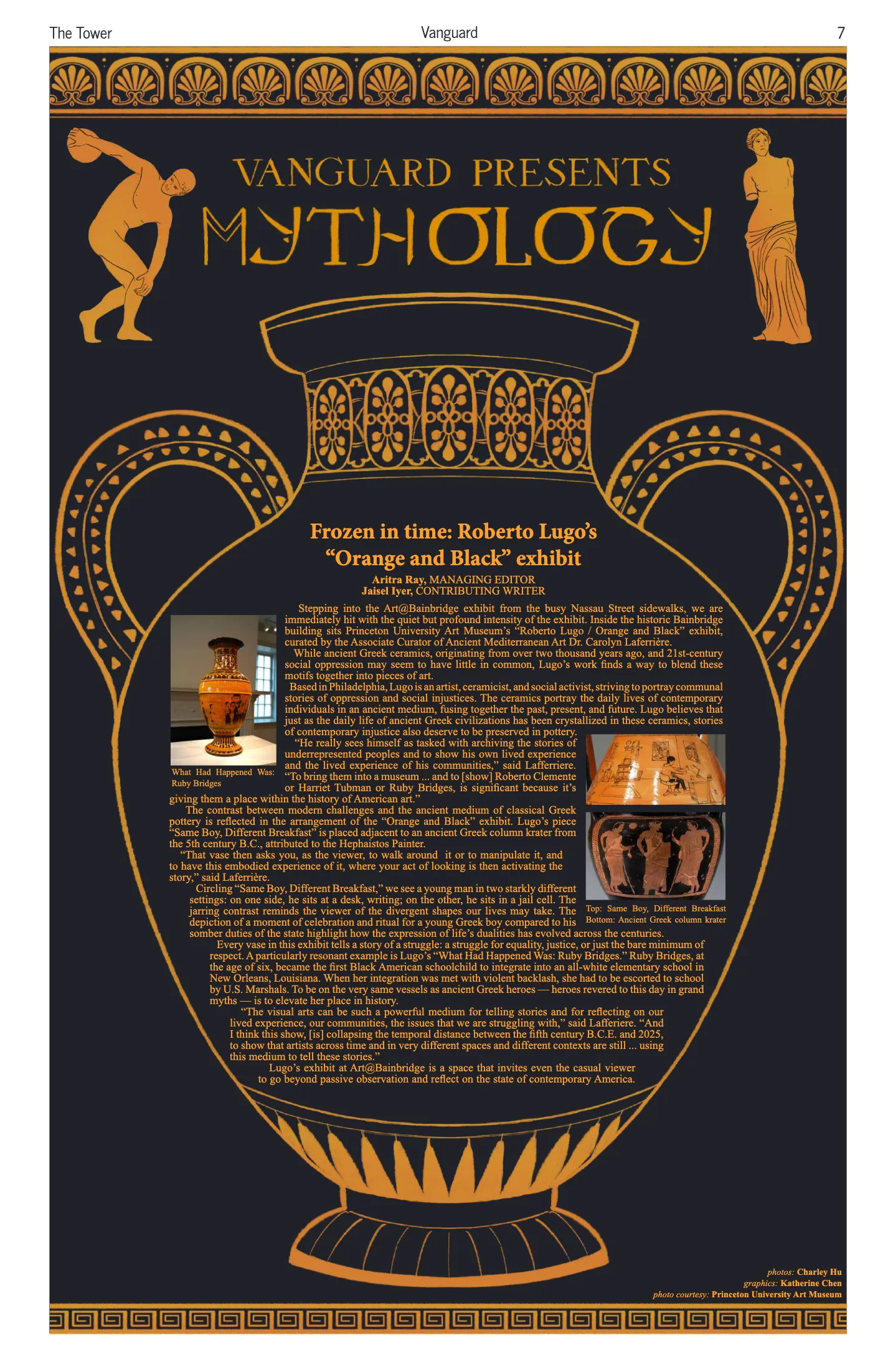
The contrast between modern challenges and the ancient medium of classical Greek pottery is reflected in the arrangement of the “Orange and Black” exhibit. Lugo’s piece “Same Boy, Different Breakfast” is placed adjacent to an ancient Greek column krater from the 5th century B.C., attributed to the Hephaistos Painter.
“That vase then asks you, as the viewer, to walk around it or to manipulate it, and to have this embodied experience of it, where your act of looking is then activating the story,” said Laferrière.
Circling “Same Boy, Different Breakfast,” we see a young man in two starkly different settings: on one side, he sits at a desk, writing; on the other, he sits in a jail cell. The jarring contrast reminds the viewer of the divergent shapes our lives may take. The depiction of a moment of celebration and ritual for a young Greek boy compared to his somber duties of the state highlight how the expression of life’s dualities has evolved across the centuries.
Every vase in this exhibit tells a story of a struggle: a struggle for equality, justice, or just the bare minimum of respect. A particularly resonant example is Lugo’s “What Had Happened Was: Ruby Bridges.” Ruby Bridges, at the age of six, became the first Black American schoolchild to integrate into an all-white elementary school in New Orleans, Louisiana. When her integration was met with violent backlash, she had to be escorted to school by U.S. Marshals. To be on the very same vessels as ancient Greek heroes — heroes revered to this day in grand myths — is to elevate her place in history.
“The visual arts can be such a powerful medium for telling stories and for reflecting on our lived experience, our communities, the issues that we are struggling with,” said Laferrière. “And I think this show, [is] collapsing the temporal distance between the fifth century B.C.E. and 2025, to show that artists across time and in very different spaces and different contexts are still … using this medium to tell these stories.”
Lugo’s exhibit at Art@Bainbridge is a space that invites even the casual viewer to go beyond passive observation and reflect on the state of contemporary America.