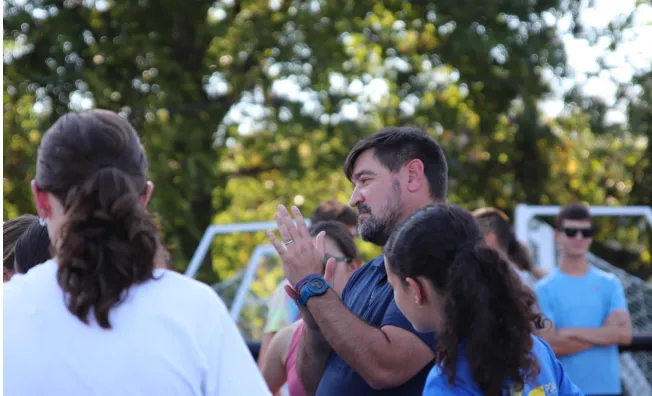
How did you get into coaching cross country?
Yeah, a little bit of a funny story, I was teaching here and I was actually coaching the ultimate [frisbee] team as a club sport, and [cross country] had an opening, and the athletic director at the time, John Curtis, had employed my wife as a soccer coach here. And [he] was like, “I heard you ran cross country.” And I was like, “that’s true,” [so he said] “I’ve got a job for you.” And that’s how I started. So that was 21 years ago.
What is training like, typically?
It’s really dependent on the number of years the runner has been running, how fast they are and their biological age, so it’s a kind of broad range. For some kids, it’s as little as a mile or two, and then a lot of strength and conditioning all the way up to some kids are going. [On] some days, long runs are 12 [to] 13 miles. And then there’s different types of workouts that go on in there as well ... they’re very individualized. And we actually empower our athletes to make positive decisions in our training. So we give them the framework, and then we expect them to grow into making decisions about how to maximize that training.
How has your coaching philosophy changed over time?
I think initially, when I started coaching, philosophically, I was very traditional ... We got to go into these things with the intent of very specific outcomes. And it was very top-down, and that was kind of classic for the type of coaching that I received growing up and over time, what I realized is that developing leaders yields positive results, and so we shifted pretty heavily towards this idea that we can do this high quality training and work, but really empower our athletes and have them become self-aware and self-deciding about their own. And so we really have moved towards that idea that we talk about things on our team, about the value of the work we’re doing right versus the time that we ran.
Have you helped create any rituals or traditions that the team currently has?
We have two kinds of long standing traditions. We’ve got Tiger Tough, [which was] created by Coach Godudo, who is an assistant coach of mine. We have a meeting on Fridays ... You just stand up when you feel that you want to speak on behalf of someone and tell us why you think they are Tiger Tough, why they exemplify the goals of the team ... When you are Tiger Tough, you get a stuffed tiger, and it is passed from [each] Tiger Tough person every week ... you’re requested to carry the tiger everywhere you go, so he comes with you to class. The other tradition is runner of the week, and this one much the same way we talk about each other, but it’s more focused on performance, and at the end of that, we have a prize box of things that people have donated to the program ... [these traditions are] really meant to celebrate our successes above and beyond.
How has the sport of cross country training changed over the years? And how are you adapting?
Well, we’ve got the sport has gotten much faster ... Training wise, we’ve made some adjustments. We spend a lot more time improving overall athleticism, because we find when we do that our athletes are able to stay healthy. And really, we focus a lot on that process and that concept. What hasn’t changed is we believe in our athletes for the time they’re with us ... Some of our athletes run for me three seasons a year, [for all] four years, and you spend all that time providing them the support and opportunity that we can ... We have some seniors who are really finally ready to kind of compete at a higher level [but you] wouldn’t necessarily identify that kid the first day [of practice]. And that process has been long and arduous and meaningful, and because of that, I’m incredibly proud of them and that journey, and I think that’s really one of the core things about our team that’s unique.
During matches, are there any strategies like that you would fall back to?
Other than being faster than the other team? We firmly believe that what we do in practice should be simulating what we’re doing. Kind of, one of our core ones is how we approach racing on hills. We use what’s called the three P’s, which is press, pass, and punish. So when we run hills, our goal is not necessarily to run faster than someone on the hill, but it’s to force them into a decision. So we like to get close enough to them that they either decide they want to run faster than they want to or run slower than they want to, and then based on their decision, we then react ... A lot of our race strategies are built around that idea ... Probably the biggest strategy we employ is athletes make decisions every single day when they train. So we expect when the guns go off, for them to make decisions. We preach that from day one, the only bad decision is indecision.
What has been, or have been, your proudest moments of this season?
I’m really proud of the fact that our athletes are willing to risk for themselves, but also for each other. You see our veterans going and, you know, chat up a kid who’s maybe five weeks into their running career, and say, “Hey, I saw you doing this, let me talk to you about this, or let me show you a different way.” Just having the courage as a teammate to say this person is valued because they’re part of our program and I’m going to invest in them ... Race results, scores, winning championships, those things are all end products, [but also] good community, good coaching, good athletes, effort and commitment. We’re proud for [the results], but it’s really more that we’re proud about the process.
What is your attitude in the face of adversity?
So probably one of the things that makes our group unique is [we] actually embrace adversity and conflict. We believe that, if you want to be great, you have to be willing to have positive conflict with the people around you ... Everybody has challenges. Maybe they aren’t bringing their truest self to that moment, sour positive conflict is about trying to find that ... The reality is, it’s never perfect. Of course, it’s too soft, it might be raining, it’s too hot, it’s too cold, the wind is too windy, whatever. There’s a lot of things outside of our control, and we get pretty comfortable with that idea. We really do focus on things that we have control over, which is our own decision making, in our own performance.