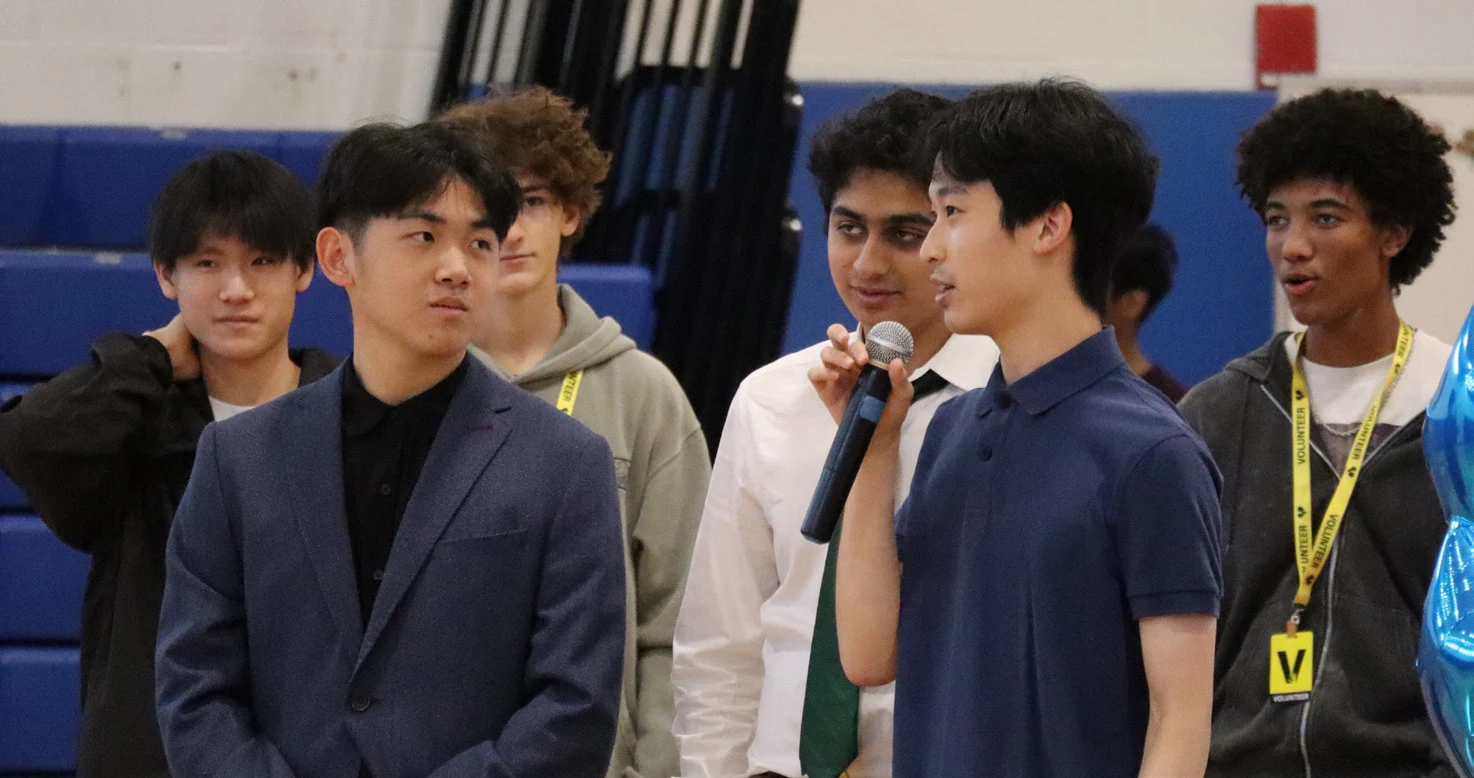
Organized by students primarily from the PHS Competitive Programming and Math Teams, the school’s annual 24-hour hackathon returned for their seventh year on October 10– 11. With the option to stay overnight, students from New Jersey to Canada participated for free at the high school to collaborate, build skills, and create projects.
This year, the theme was “Into The Skies.” The students used their own creativity to interpret the theme by themselves and incorporate it in their creations. Those who were a part of the event were tasked with building a website, device, or an app to help solve a problem in the aerospace field. During the main event, the hackathon, students worked in teams of up to four to create their project. At the end of the building period, the projects were judged based on functionality and thoughtfulness, giving them a chance to win prizes like gaming devices and website subscriptions.
Throughout the event, organizers also hosted workshops that taught them concepts like neural networks, circuitry, Python, as well as separate competitions that tested different skills and quick coding ability for points and prizes.
The team started planning around March and had around 30 organizers. It took them around 18 weeks of planning out the schedule, getting sponsors to fund the event, doing outreach on social media, and reaching out to other schools
John Patrick-Aguilar ’28, an organizer for the event, shared more insight into the outreach process and how they were able to spread the word about the event.
“This year, the outreach team sent information out to teachers all across New Jersey, and they advertised hackPHS on multiple websites dedicated to supporting hackathons,” said Patrick-Aguilar.
Around 400 participants signed up for hackPHS, a large increase compared to last year’s 117. The leaders were able to reach students from all over, and greatly increased the impact it had on the community. The team initially planned for around 200 people but had to change their process after over 400 students signed up. 383 of the 400 registered participants attended the hackathon.
Shaurya Ranjan ‘27 shared some insight on how the whole process was like behind the scenes.
“We weren’t sure how we were going to feed that many people. The two weeks before hackPHS ... entailed us running around trying to get more sponsors because a lot of sponsors were giving us food ... [or] cash to help pay for food,” said Ranjan. “Even though I didn’t work in the finance division, I kind of helped them get sponsors. We ran into Charles Schwab in Princeton, Wells Fargo, Chase Bank, PNC, TD Bank, and all the banks in the area. ... The whole community really pitched in and helped us feed all the people that we weren’t expecting. That was great.”
Ranjan also shared some struggles throughout the event that forced the team to plan effectively and often on the spot for the amount of people.
“So space did become limited, and we had people sitting on floors and stuff,” said Ranjan. “The complaints about the crampedness and the capacity kind of went away after an hour or so, but the initial hour was kind of chaos. … As much as we understood that being cramped isn’t an ideal working condition, we did want to ensure that the competition was fair for everybody.”
Saturday began at 10:00 a.m. with the opening ceremony. Following that, students had the option to listen to a variety of talks from experts on topics including engineering and neuroscience.
“The guest talks were super, super cool. We had a Princeton professor, a Princeton postdoc researcher, and then an undergrad from UNC Chapel Hill speak about their experiences with computer science,” said Ranjan. “I personally taught the Intro to Neural Networks workshop, and it was great.”
Apart from the STEM-related activities, students were also able to enjoy the provided food and activities such as karaoke, chess, movie night, and games. Activities continued for the entirety of the 24-hours.
Sophomore Darren Kapturski, a student from Bergen County Technical High School, heard about hackPHS from searching up hackathons online.
“It’s not something you can do on a daily basis, especially with a lot of schoolwork and stuff, so it’s really fun and a nice way to step outside your comfort zone,” said Kapturski. “I feel like I learned how to implement AI more into my work.”
Eric Yee ’28 from Council Rock High School heard about hackPHS from co-leader Oscar Huang ’27.
“I think it’s a good way to present ideas, to explore issues together, work in a team, and overall, just to be in a community where everyone can collaborate and just be around like-minded people in general,” said Yee.
Adam Kaplan ’27, a student who participated in hackPHS last year, shared his personal experience with the success of hackPHS from 2025.
“I did [hackPHS] last year and it was pretty fun. My favorite thing about it would probably be meeting a group of people and working with them,” said Kaplan.
Organizers emphasized the need for earlier planning next year, but said that overall it was a positive, team-building experience. They plan to host the event again next year.
“It was a great moment to … be really part of this 300-plus people operation. … What we code and what we do with STEM has implications beyond just PHS and has an effect in greater society and impacts real lives.” said Ranjan.