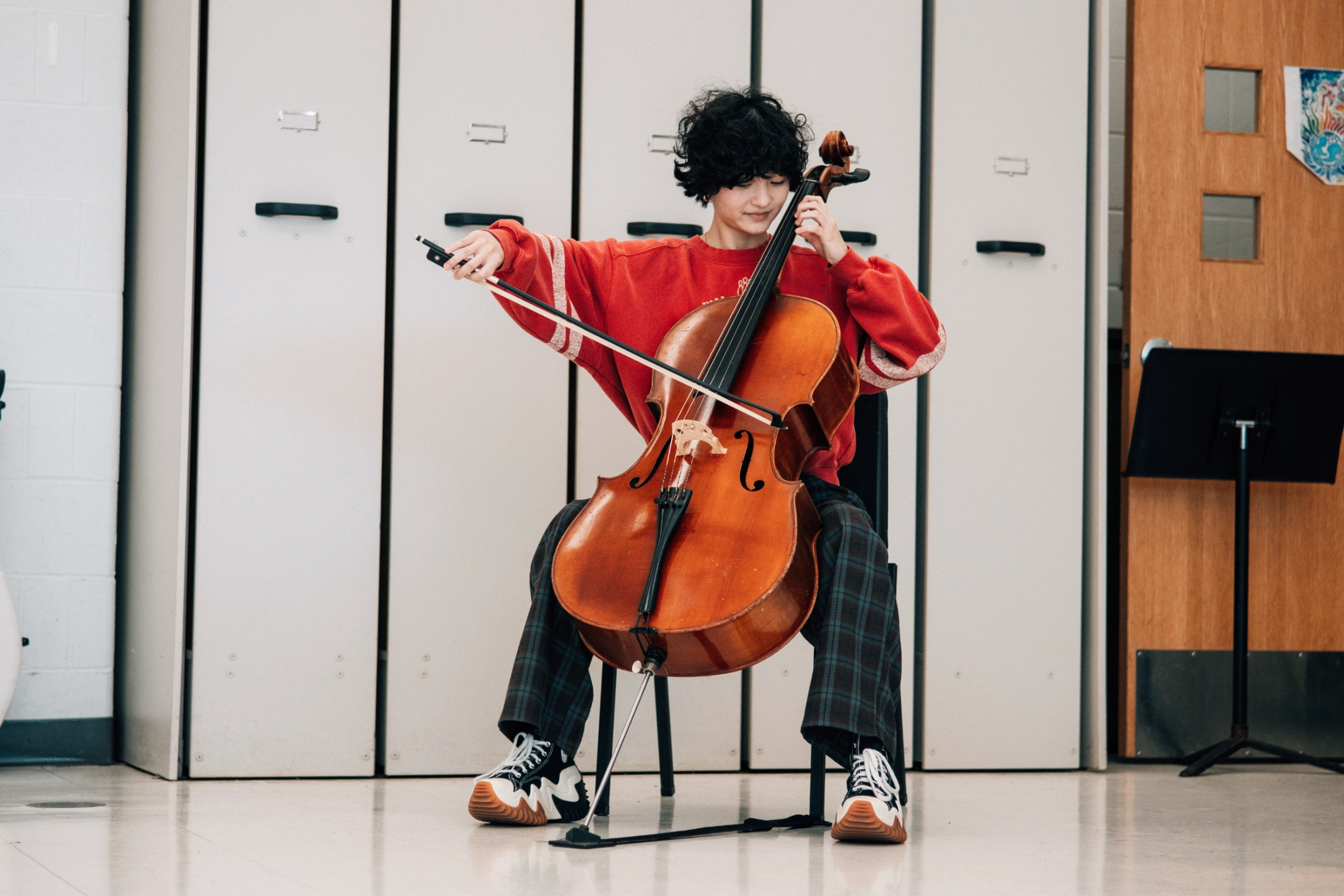
Every Saturday, Alice Leng ’27 wakes up early, packs her cello, and drives an hour to Manhattan. Her destination is the Juilliard School of Music, where she has participated in the Pre-College Orchestra and program as a cellist for the past year. Closer to home, she has also spent four years as a member of PHS Orchestra (PHSO) and plans to incorporate music into her college experience, even if that doesn’t look like the traditional path of studying at a conservatory.
How has playing the cello impacted your high school life?
[Playing the cello is] something you need to devote a lot of time to, and it’s something that I work on [outside of] homework and tests. I also have to take time out of my day [to] practice. But I think there’s nothing inherently bad about having to do that, because I have the privilege of knowing how to play an instrument and being able to showcase that. ... I think the way that you practice also impacts how long you have to practice, what level [of playing] you’re at, and if you can do these concerts and experience the best of what music can give you. So it’s a really big privilege. ... I also learn stuff that I can apply to [other parts of my] education. [Playing the cello is] not just an extracurricular, it does spill into other [things] that I’m interested in, like being patient. Practicing, learning to give myself time for certain pieces and redoing [those pieces] over and over again. I also really get a lot of enjoyment from [playing]. ... [When] I listen to other people play, I can understand [their] music in a much higher way. ... I get to understand all the effort that [goes in to] all of those concerts. So that’s really great.
Do you have a role model or someone you take inspiration from? How have they changed the way you play cello?
I find it super helpful to have a role model. Everyone’s unique interpretations [of music], in my opinion, come from some kind of outside source. Apart from just the influences that you can see, like that I was inspired by this person or I listen to this person a lot, there’s also ... technique [and] practice style that comes from other people. [Also] the surrounding you’re in. Being in the PHS Orchestra and doing other orchestras outside of school really impacted me because I got to see how all of my classmates work on a piece of music and react to music, and that influences the way that I work. So I guess [I have] a lot of influences. The big one is [my] surroundings, how other people around me react to music, both unconsciously and on purpose.
How does your PHSO experience compare to your orchestra experiences outside of school?
I’m in the Juilliard Pre-College Orchestra. [Compared] to PHSO, there’s not that big of a difference. Both orchestras have strengths and weaknesses. ... In those two different orchestras, ... I get to experience something different and my classmates have different attitudes because obviously [in PHSO] we’re all from Princeton, [whereas] everyone [in the Juilliard Pre-College program] is from different places. Being part of two different orchestras also showed me what it’s like to pursue music professionally, because ... I have to commit myself to different orchestras and different conductors. It also showed me the [difference in the] styles of conductors and the importance of having a really good conductor. My Pre-College conductors regularly switch [out]. We have some guest conductors, ... [and] they all have completely different styles. It’s really interesting that part of playing orchestra these days [is] knowing how to adapt and change how you approach music based on what the conductor asks you to do. In both orchestras, we tackle really difficult pieces, [like] concertos [and] symphonies, and at PHSO, we do a lot of themes as well. ... Knowing how to change how you [play] music based on who’s next to you or who’s conducting and understanding the importance of the people that you do music with, like the conductor, [is key]. And being able to play with solos too [is different], because at Juilliard it’s much [rarer] than PHSO, because a big part of PHSO is ... the senior solo recitals. That’s really different. But ... right now I’m preparing my senior solo for PHS. It’s really a great experience, ... and I think the level of PHSO [and] the level of the Pre-College [Orchestra], are so high [that] I can experience a lot of different things despite not playing the same pieces.
Can you elaborate about the solo you’re preparing with PHSO?
I’m doing the Elgar Cello Concerto in E minor, first movement. [In my] classes at [the] Pre-College [Orchestra], sometimes I play [the piece on] with piano accompaniment. I would say it’s one of my pocket pieces, it’s a piece that I know really well. But playing [with] the orchestra is a completely different experience than playing with the piano. The orchestra is just so much more astonishing [and] so much more grand. ... I’m pretty affected by how the people playing with me react to my playing, so when they give me really good support, I can express [myself] more. PHSO does a really good job of doing that, so I [have] really enjoyed the preparation process so far.