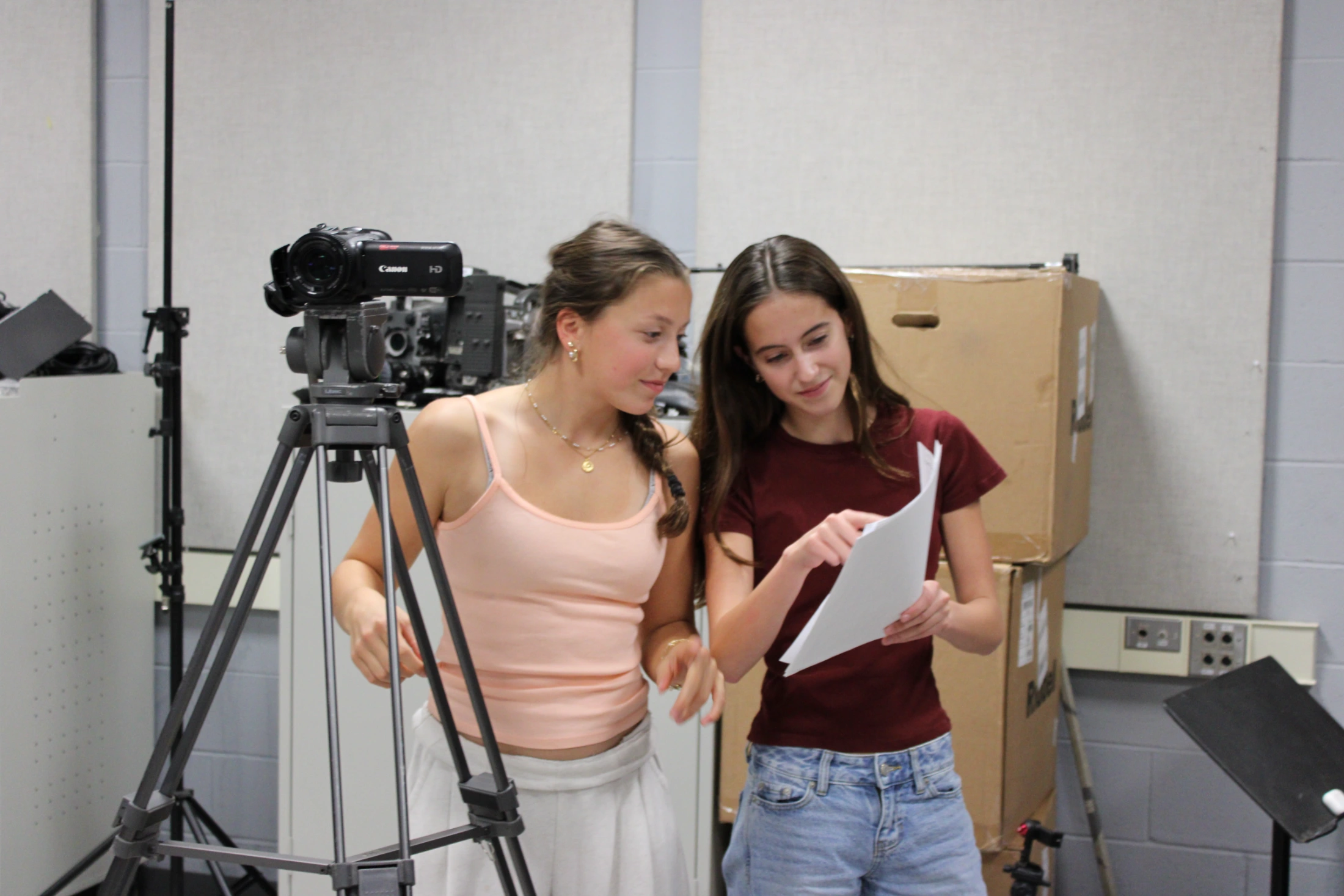
Every week, PHS homerooms used to be filled with the sounds and energy of a student-run television broadcast. The broadcast, named “The Tiger News,” covered sports, music, weather, and school news, operating similarly to a professional news show. Students would work on production in the PHS TV Studio and air the next day, oftentimes with at least 12 students manning several different stations. According to faculty, the broadcast was incredibly popular, and built a strong sense of community within PHS.
The broadcast also helped inspire an interest in visual media for more PHS students, to the point that PHS had to bring in three more filmmaking and video production teachers.
“I think we already have tremendous interest. … The idea, first of all, of seeing their friends up on television, is a neat thing. It could probably drive more people to sign up,” said PHS Video Production teacher Charles Gallagher. “They brought in more teachers to teach more of the classes. So, I think the proof is in the pudding.”
While school administration is open to the thought of re-implementing a student broadcast, PHS students have limited knowledge about the student broadcast, and thus don’t frequently bring it up.
“At this point, most of the students don’t know anything about this. … I have tried to stimulate conversation, … and our principal is open,” said Gallagher. “She has listened, which has been fantastic.”
The broadcast operated from roughly 2006 to 2016, but had to cease operation due to aging equipment and its high replacement cost. According to PHS Principal Cecilia Birge, the broadcast was funded through grant money from the technology department and a partnership with The College of New Jersey (TCNJ), which gave PHS access to what was, at the time, state-of-the-art broadcasting equipment.
“The broadcasting studio … was funded by grant money and a lot of generosity from TCNJ,” said Birge.
However, getting that money again and re-outfitting a studio poses high financial and logistical concerns. Implementing newer, up-to-date recording equipment has been estimated to cost PHS anywhere from $150,000 to $250,000. According to the administration, not only is spending so much money on equipment that has to be replaced every few years not practical, but, to justify the cost of broadcasting equipment, PHS would have to make participation on the broadcast accessible for more students.
“When you have a classroom that only can take 14 students, that’s not economical. So I would have to move that studio out elsewhere so that I can open up the class to 25 students,” said Birge. “Then more students can enjoy a really engaging elective course rather than just a few students in a small space using very expensive equipment.”
During its time at PHS, The Tiger News was said to have an overwhelmingly positive effect on students and the greater PHS video production community. According to Gallagher, producing the broadcast allowed students to develop skills that are highly applicable in the real world.
“It … has real-world applications. I love the fact that students are able to get up and go talk to people and develop great interpersonal skills or interpersonal relationships with kids and adults,” said Gallagher.
Allison Wang ’27, a member of the PHS Filmmaking club, said that she was unaware of PHS’s history of student broadcasting. However, she believes that reintroducing a student broadcast could bring more visibility to filmmaking and video production at PHS, and supplement the video production resources that are available for more experienced PHS filmmakers.
“There are resources, like the club and the [filmmaking] class, which I think are good for a beginner, but if you want to be more intermediate, then PHS lacks resources,” said Wang. “I think [a student broadcast] could help provide more hands-on experience and make filmmaking more visible within the community.”
To fund a student broadcast, both Birge and Gallagher suggested that there is a great deal of grant writing that must be done, as well as initiating connections with people who are well established in the video production industry for potential funding. While fundraising has worked for PHS in the past, securing the necessary funds for a student broadcast on fundraising alone is not feasible.
“I’ve worked with Mr. Gallagher for a couple of years, really trying very hard to look for grant money, exploring different ways to rebuild the broadcasting news program. And so far, we haven’t been very successful,” said Birge.
While several other schools in the area do have some form of a student broadcast, Birge highlighted the difference between their programs and that of PHS. According to Birge, many of the other schools’ programs rely on pre-recorded content that is then uploaded to certain sites and can be streamed by students. In contrast, PHS’s broadcast was far more reliant on the live broadcast that came from the TV Studio.
“Their technology and class format is different. Additionally, we were so dependent on that studio,but I don’t think theirs is a full studio experience like ours. Their output is more video driven rather than a whole broadcasting experience,” said Birge.
While securing funding and equipment for a student broadcast remains a challenge, administration emphasized their support for the implementation of a student broadcast.
“Our students want it. Our teachers want it. It’s just like I said, it’s space and money,” said Birge. “The will is there. The desire is there. It just takes time to implement it.”