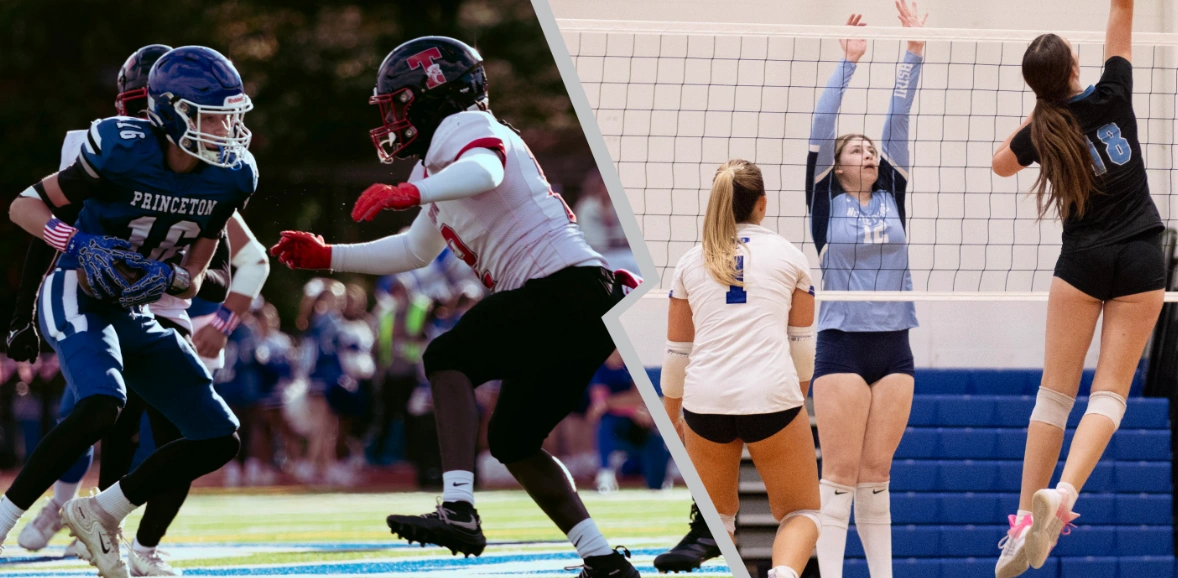
No matter how many new faces there are, the PHS sports scene remains constant to some extent: whether there are incoming players or the promotion of a new coach, the same group of schools consistently appear in the schedules. As a result, rivalries have developed from playing the same teams, creating close competition between schools.
“[Having a rival school] definitely makes everything more competitive, especially toward the end of the season when we’re entering championships,” said cross country runner Miles Vanderpool ’28.
Rivalries differ by sport: Allentown in football, West Windsor-Plainsboro North in cross country, Princeton Day School for lacrosse, and Notre Dame for volleyball. At home games, the PHS community shows up to contribute to the game-day atmosphere that helps drive team momentum.
“A lot of the hype that comes with rivalries, including the Tiger Cage and a large student section, really brings a lot of energy to the school and a lot of attention to our program,” said volleyball player Lucy Wang ’27.
The community support brought to these high-intensity games encourages the athletes to perform at their highest level. This motivation is especially evident when facing longtime rivals of PHS, as both teams are determined to outperform their competitors. The intensified desire to win in order to prove themselves against familiar opponents can create additional pressure on athletes to give their strongest performance.
“Against the teams that are beatable, it really gives me this energy of wanting to play to my best potential because I really want to beat the team and have that satisfaction,” said lacrosse player Naomi Takavarasha ’29. “[I put] a lot of pressure on myself [because I want] to be the best I can.”
While the intensity of a rivalry can make a win or a loss feel especially significant, the outcome of a single game does not define an entire season. Teams try to avoid dwelling on losses, and instead, they shift their focus to improving for upcoming matches. This mindset helps atheletes they stay concentrated instead of getting caught up with the past.
“Whenever we win or lose, no matter what, the next practice is like a fresh start,” said football player Aryan Kondakindi ’29. “We don’t think about past weeks. We’re just thinking about being 1–0 at the end of the week.”
Team rivalries contribute to large portion of high school sports, but it’s not always about the competition. Winning and claiming bragging rights are fun, but they are the byproducts that come from teams putting in the work throughout the offseason and during practices. The connections formed by the work teams put in for these frequent matches build a community off the desire to improve with one another.
“Rivalries can definitely bring the community together, especially with huge events and announcements on Instagram,” said Wang. “Large crowds that come to watch our games definitely bring a lot of cheer and [provide an] opportunity for students to relax and do something fun after school.”