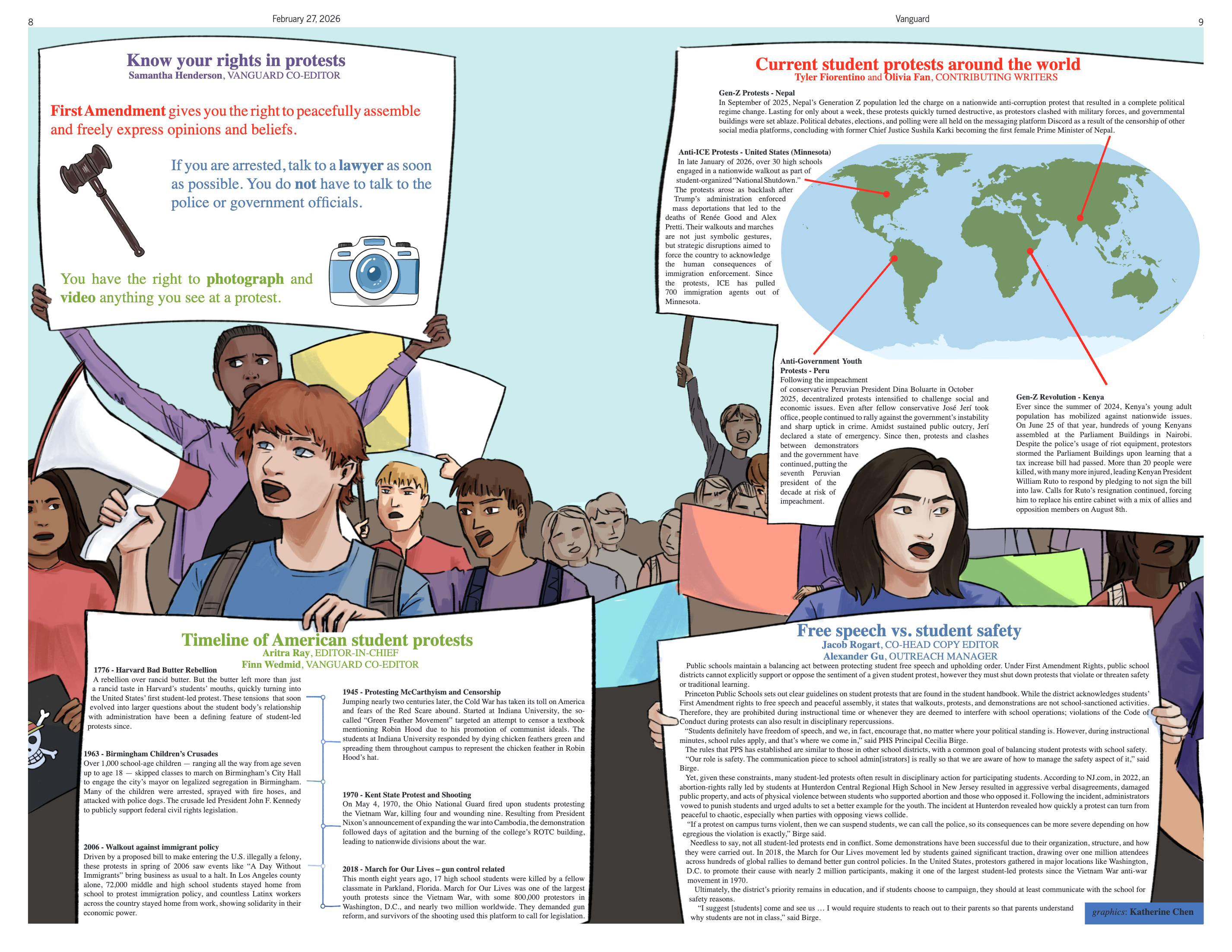
Public schools maintain a balancing act between protecting student free speech and upholding order. Under First Amendment Rights, public school districts cannot explicitly support or oppose the sentiment of a given student protest, however they must shut down protests that violate or threaten safety or traditional learning.
Princeton Public Schools sets out clear guidelines on student protests that are found in the student handbook. While the district acknowledges students’ First Amendment rights to free speech and peaceful assembly, it states that walkouts, protests, and demonstrations are not school-sanctioned activities. Therefore, they are prohibited during instructional time or whenever they are deemed to interfere with school operations; violations of the Code of Conduct during protests can also result in disciplinary repercussions.
“Students definitely have freedom of speech, and we, in fact, encourage that, no matter where your political standing is. However, during instructional minutes, school rules apply, and that’s where we come in,” said PHS Principal Cecilia Birge.
The rules that PPS has established are similar to those in other school districts, with a common goal of balancing student protests with school safety.
“Our role is safety. The communication piece to school admin[istrators] is really so that we are aware of how to manage the safety aspect of it,” said Birge.
Yet, given these constraints, many student-led protests often result in disciplinary action for participating students. According to NJ.com, in 2022, an abortion-rights rally led by students at Hunterdon Central Regional High School in New Jersey resulted in aggressive verbal disagreements, damaged public property, and acts of physical violence between students who supported abortion and those who opposed it. Following the incident, administrators vowed to punish students and urged adults to set a better example for the youth. The incident at Hunterdon revealed how quickly a protest can turn from peaceful to chaotic, especially when parties with opposing views collide.
“If a protest on campus turns violent, then we can suspend students, we can call the police, so its consequences can be more severe depending on how egregious the violation is exactly,” Birge said.
Needless to say, not all student-led protests end in conflict. Some demonstrations have been successful due to their organization, structure, and how they were carried out. In 2018, the March for Our Lives movement led by students gained significant traction, drawing over one million attendees across hundreds of global rallies to demand better gun control policies. In the United States, protestors gathered in major locations like Washington, D.C. to promote their cause with nearly 2 million participants, making it one of the largest student-led protests since the Vietnam War anti-war movement in 1970.
Ultimately, the district’s priority remains in education, and if students choose to campaign, they should at least communicate with the school for safety reasons.
“I suggest [students] come and see us … I would require students to reach out to their parents so that parents understand why students are not in class,” said Birge.