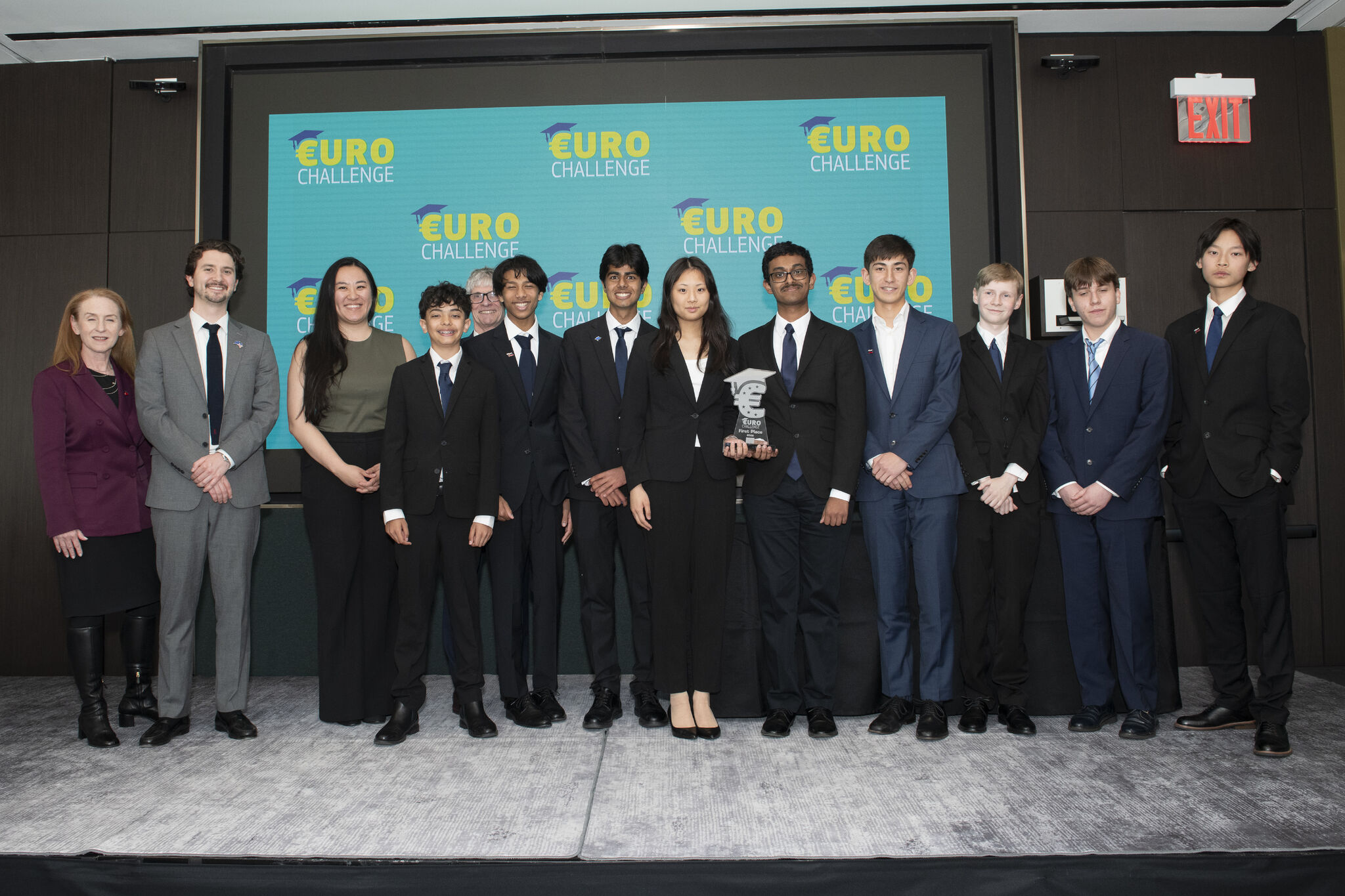
On April 27, the Princeton High School Euro Challenge team placed first at the National Euro Challenge, an annual economic policy competition for U.S. high school students to learn about the European Union and its currency. Each team picks a country that is in the eurozone, and presents that country’s economic policy problems and solutions for chosen issues. Following PHS’s first place victory, they traveled to Washington D.C., where they met with an ambassador of their chosen country and discussed the real-world implementation of their research.
PHS’s team captains Aritra Ray ’27 and Helen Yu ’27 chose Slovakia this year, focusing on discussing the country’s potential economic growth and prosperity. Yu explained what challenges the team faced during the preparation for the competition.
“There’s a lot of parts where we thought the solution was not specific enough ... so we had to think, ‘What else can we do that will help bring up a new section that hasn’t been paid a lot of attention to?’” said Yu. “In general ... we had to build a team dynamic, and we had to make sure that overall our presentation wasn’t monotone.”
The team had to divert slightly from their usual process, especially with regard to overall productivity, after not placing first for about five years, though the team did have a fourth place finish last year.
“I think this year we stayed a lot more on task. Having a strict schedule really built [us] up for success, because on the day of the competition, all our members had everything that they needed to know,” said Yu.
While Yu and Ray played a role in the research process and the management of the group, the presentation was designated to the freshman and sophomore team members.
“Every year, we pick people [to make the presentation more engaging]. So I was Michal Meško, a [Slovak entrepreneur] ... [and] Rohan was the minister of economics,” said Sebastian Balestri ’28, one of the PHS presenters.
Along with the changes on their presentation, the club’s advisor, PHS chemistry teacher Matthew Krip, noted another unique feature of the PHS team, and other PHS clubs in general, highlighting their student-run nature.
“That dynamic is unlike any other school that was [at the competition], and coming as the teacher who believes in that type of pedagogy, the dynamic is that the students who had competed previously, they became the leaders,” said Krip. “That’s the ideal pedagogy, because when I saw the other groups, the teachers were pretty much advising everything.”
As a prize for the team’s first place victory, on June 2 and 3, the team traveled to Washington D.C. to meet with Slovak ambassador to the United States, Matúš Huťka, and explore the possibility of turning their ideas into a reality.
“I think it’s about realism and meeting people who have influence, and hearing their perspective validated, and that’s very empowering. Any person who has put enormous amounts of time and research into a certain subject, and then going to an authority in some way, honestly, it’s kind of interesting,” said Krip.
The team spoke to the Slovak ambassador and other Slovakians, hoping to explore the viability of their ideas and whether they could have a real impact.
“I really want to talk to the [Slovak] people, and then [see] if our solutions would be something that they would consider ... and I just want to see how they would respond to [these problems], [if] this is something they’ve considered in the past, and why they haven’t done anything about it yet,” said Yu.
Unlike other clubs, the Euro Challenge club allows team members a hands-on opportunity to step into the role of policymakers and carve their own solutions.
“I think Euro Challenge really offers a unique experience, especially when it comes to ... formulating your own solutions,” said Balestri. “That’s not something that you get with many other clubs.”
Ben Carliner, a senior economist at the EU Delegation who worked with the Euro Challenge organizers to plan the Washington trip, echoed a similar idea.
“Putting [students] in front of [adults] who will take [their] ideas seriously and ask questions ... really prepares [them] for the kind of work [they’ll] need to do in the real world,” said Carliner.