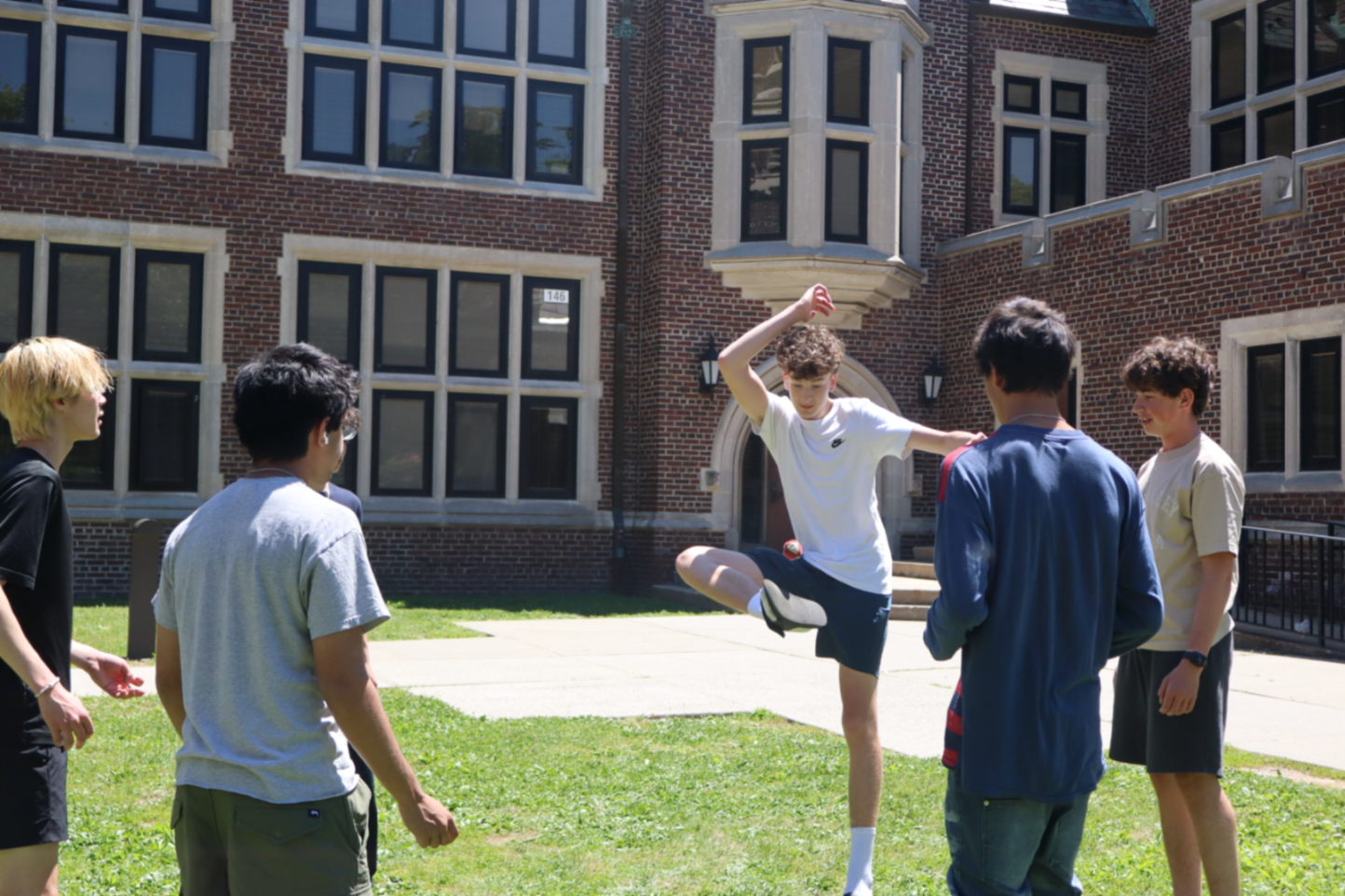
Starting this year, a resurgence of classic backyard games has swept the nation, with teenagers across the United States reviving recreational pastimes such as frisbee, wiffle ball, cornhole, spikeball, and especially hacky sack. The recent comeback of these sports has reached student life at Princeton High School as well, with students all across campus participating. With little equipment necessary and a spontaneous nature, these backyard games are bringing students together, encouraging them to unplug and stay active throughout the day.
Hacky Sack
The origins of hacky sack can typically be traced back to 1972 at a local festival in Oregon, where co-inventors Mike Marshall and John Stalberger met. Marshall introduced his friend to a hobby learned from his time with Native Americans, kicking a bean bag back and forth for hours on end. Entranced by this rudimentary but engaging hobby, they birthed their company Hacky Sack.
Starting in the Northeast just after spring break, many high schoolers were introduced to the new sport. Spreading like a wildfire through social media, schools have even started forming hacky-sack teams that range from the varsity level to exclusively freshman. PHS has decided to join in on the fun too.
Most recently, PHS varsity sacks has been participating in a state wide hacky sack tournament featuring a $4,000 prize for first place. Each submission consists of a video, showcasing one round of hacky sack, with the public voting for the winner. Members of PHS’s own varsity sack team have been putting up flyers to promote participation in voting. Winning both the rounds of 64 and 32, this strategy seems to be working. The future success of our varsity sack team rides on both the skills they can bring to the table and the school spirit we can back them up with.
These sacks are technically called foot bags, with Hacky Sack being just a brand name. But nevertheless, retailers of all kinds are scrambling to keep up with the demand. Co-owner Joanne Farrugia at Princeton’s local toy shop Jazams emphasizes this point.
“We brought in several hundred and then sold out pretty quickly, and then brought in more, sold out pretty quickly” said Farrugia. “Now we have another huge order coming in. So, hopefully that will last a little while.”
With this craze infecting the hallways of PHS, students have been finding every chance to play. Many see this revival being a good thing for the students, with one being Marion Walsh ’29.
“I think it benefits society because people are together, having fun, [getting] physical exercise, [and] forming friendships and bonds over such a beautiful game,” said Walsh. “It’s just a part of my life now, and I wouldn’t have it any other way.”
The hold that hacky sack has on this generation can be attributed to its sociable and simple nature. Constant overlap in action forces communication, making hacky sack a great way to build connections. Along with this, all that is needed is a sack smaller than the size of your palm, allowing games to take place anywhere, anytime.
Frisbee
Another backyard game that is popular in the United States today is frisbee. Although activities similar to frisbee can be dated back to the 8th century B.C., the sport was mainstreamed in the United States after the inventor Fred Morrison created a plastic disc inspired by flying saucers. Since then, frisbee has grown into a sport played in at least 70 countries around the world.
Frisbee encompasses many different playstyles, ranging from ultimate frisbee to disc golf. Ultimate Frisbee is played in a similar way to American football, except that instead of a football, players throw a disc around. In recent years, many competitive Ultimate leagues have been established across the United States for all ages. Disc Golf is usually perceived as a more casual way to play frisbee, usually found in parks or on beaches.
Since many frisbee games can be played either competitively or casually, the sport impacts all kinds of PHS students, one of them being PHS Frisbee Club Captain Julian Grossman ’28.
“[If you’re] on the same team, it’s a very good bonding experience,” said Grossman. “[You] get [to] exercise and be with friends.”
Grossman has been the captain of the club since the start of the 2025 school year and his love for frisbee stems from its uniqueness. Many students specifically choose frisbee over other sports because they value the sport for the people that they can bond with and get to know while playing.
Spikeball
Ever since its appearance on Shark Tank in 2015, Spikeball has taken the world by storm. The company has managed to sell over five million nets since then and the sport has become a staple part of recreational backyard or beach hangouts.
Similar to how wiffle ball is modeled off of baseball, Spikeball is a hybrid of volleyball and four square. Two teams of two players take turns bouncing a ball back and forth off of an ankle high circular net. Each team gets up to three touches — similar to volleyball — to pass the ball and spike it back onto the net. If a team misses the net, hits the rim, or uses too many touches, a point is awarded to the opposing team.
This backyard game has intrigued PHS students so much that they have decided to form a club. Run by Romy Johnson ’26 along with other PHS students, the club provides an environment for students to enjoy Spikeball while meeting new people in the process.
“I think it’s just a fun activity for me to do with my friends. It doesn’t require you to be super athletic, and it’s not like you’re getting tired because you’re just standing there, but it’s still fun and engaging,” said Johnson.
There are other factors that also may influence the appeal to Spikeball. Many people enjoy the connections that they are able to make with friends while playing while others view the game as a break from studying or work.
Spikeball’s appeal may also come from its convenience. The entire setup fits inside a drawstring bag, which allows people to play it in various environments. But what makes Spikeball stand out from other backyard games?
“Spikeball is a bit more interactive, it’s a bit more intense, getting the ball onto the net, running for it sometimes, there’s [these] fun moments that come out of it,” said Ethan Tang ’29. “Something like catch [is] just boring. There’s not a lot of stuff that happens.”