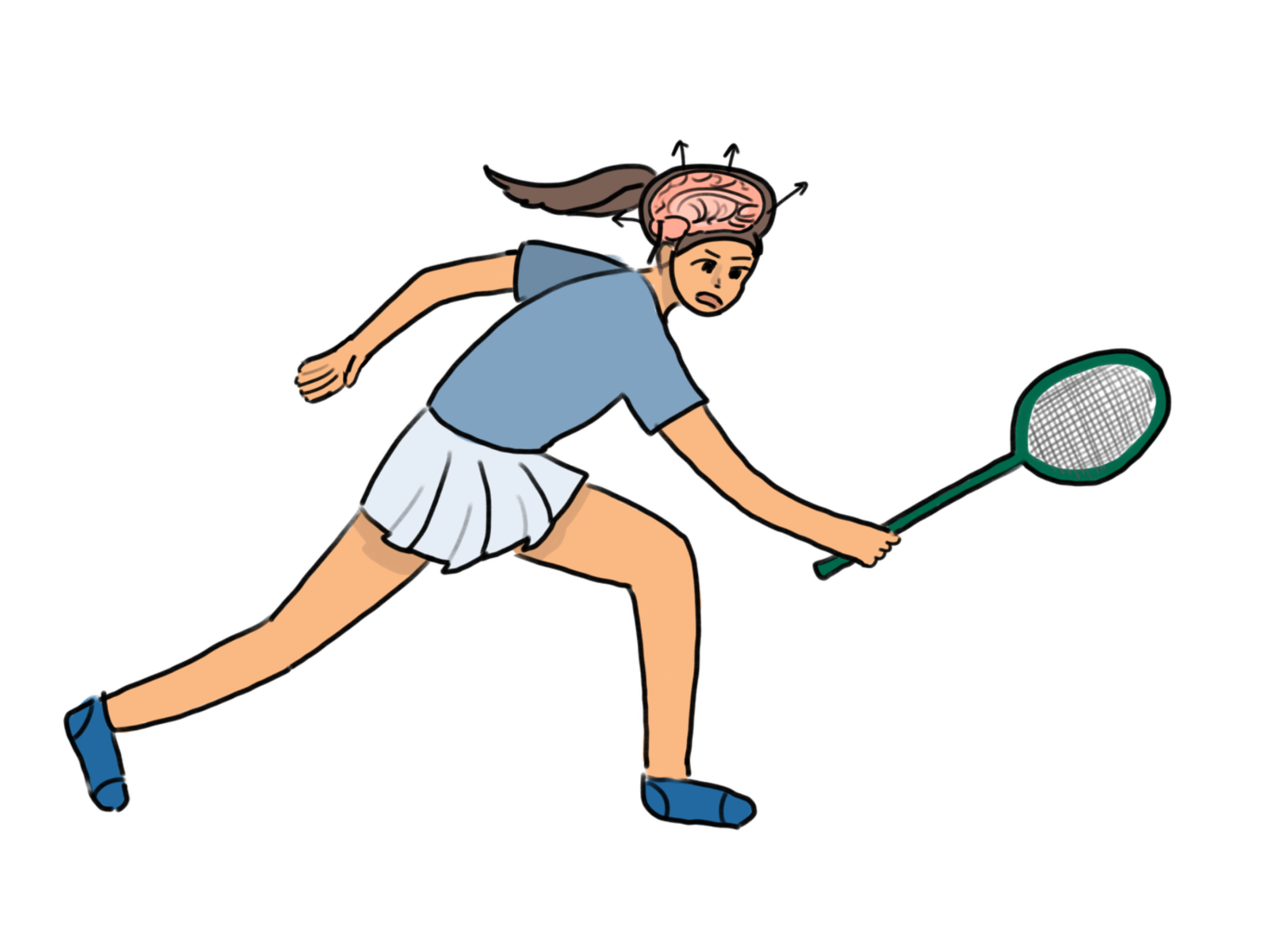
No one enjoys losing. After all, everyone wants to succeed, win, and enjoy the fruits of their labor. However, the fear of losing often accompanies the drive to accomplish, especially for athletes that are expected to perform well regardless of external or internal conditions that may impact gameplay. As a result, athletes must adopt a tenacity which allows them to handle loss, and to learn and grow from their past mistakes or setbacks.
Often, a loss can expose what a win often hides: weak communication, lazy habits, or poor decisions. When a team wins, faults in individual decision-making or teamplay may be ignored, as the guise of success and victory routinely cover up areas of potential improvement. It stands to reason that the losses hardest to accept are often the most necessary. They ask you only one thing: do you have the courage to keep going? Even at the highest level, the mind is tested, demanded, and challenged — both on the court and long after the game ends.
“Concentration and mental toughness are the margins of victory” said legendary 11-time NBA Champion Bill Russell.
Such mentality not only separates great athletes from good ones, but also exposes the depth of an athlete’s commitment. It’s easy to remain invested when success is almost habitual, when confidence is high and victory comes with ease. On the other hand, a loss commands effort and progress that is no longer glamorous. Ultimately, a loss forces an athlete to decide whether the result will carry on as frustration or instill a newfound drive to be better.
The point of losing is not to just give up what you have worked so hard for all because of a bad moment. Where there are ups, there are downs; what matters most is what you decide to do with your losses. For instance, in track, immediate reflection can look like adjusting your pace after going too fast, taking a leap of faith in yourself to go climb up a few spots, or choosing when to conserve energy and when to push following a bad start.
“There’s always something you could have done better. [I always have to think about] what [I could have] done better, what was out of my control, what I [can] control, [and] what [I can] do to come back stronger,” said Felix Yu ’27.
However, improvement is not only limited to physical training. It could also be about how an athlete approaches an event itself — how they handle pressure, make decisions, and adjust in the moment. At times, what once looked like a lack of fitness can actually turn out to be a matter of judgement. A loss can reveal problems that came from stressed nerves, a lack of proper preparation, or from the way a plan was executed differently than from practice.
“A lot of times when I lose I just think to myself it’s just a fitness issue. Now, improvement doesn’t come from better training ... [it] comes [from] just learning how to [properly] approach races,” said Yu.
A race is never decided by one moment alone. Ayrton Senna, for example, did not win his first Formula One race until his 16th start, however; that first breakthrough became the beginning of everything that followed. A race, in the same way, is rarely a reflection or summation of one’s continued work. More often, it is part of what eventually makes success possible. It can sharpen judgment, expose weaknesses, and leave behind a clearer sense of what must change before the next competition arrives.
So, the next time you end a competition on the wrong side of the scoreboard, don’t sulk over the immediate defeat. Think about what you can learn from your loss, and use that understanding in order to prepare for how you might win your next game. Success isn’t the absence of failure; it is the result of it, and the perpetual reflection of oneself on their previous losses.